
In the first two essays of this series, I argued that fear has become one of the dominant spiritual and political realities of our age. Fear shapes public imagination, fuels exclusion, and often drives people toward forms of authoritarian belonging that promise security through conformity.
Yet recognizing the problem raises a deeper question:
What comes next?
If Christians refuse Babel’s monocultural logic and resist the temptation of authoritarian refuge, how are we supposed to live?
The answer I propose in Embracing Fear is re-existence.
Re-existence is more than resistance and survival.
Resistance is necessary. Communities must learn to oppose policies, ideologies, and structures that diminish human dignity. But resistance alone can leave us trapped within the horizon of what we oppose. Re-existence asks a different question: How do we begin living God’s future now, even while the old world continues to surround us?
Re-existence does not begin by imagining a world without conflict. It begins by learning to live differently within it. Guided by the fear of God rather than the fear of empire, communities cross the abyssal lines that separate human beings into worthy and disposable populations. They participate in God’s Resistance against systems of death and cultivate forms of life where many peoples, histories, languages, and futures can flourish together. Re-existence is therefore not merely survival. It is the practice of living God’s tomorrow in the midst of today’s anxieties.
For migrant communities, displaced peoples, and those living under various forms of exclusion, this question is not theoretical. It is deeply practical and embodied. Many communities cannot wait for ideal political conditions or a romantic eschatology before they begin building lives of dignity, solidarity, and hope. They must learn to live otherwise in the present.
To Fear Empire or To Fear God?
At the center of this alternative lies a distinction that Scripture repeatedly makes: the difference between fearing empire and fearing God.
Empire teaches us to fear scarcity.
Fear outsiders.
Fear displacement.
Fear losing status.
Fear those who are different.
Fear the future.
The fear of God points in another direction.
Biblically understood, the fear of God is not terror before a punitive deity. It is reverence before the One whose love, justice, and holiness exceed every earthly power. By teaching God’s people not to fear what empires fear, the fear of God relativizes all lesser allegiances and opens the possibility of living otherwise:
Do not call conspiracy all that this people calls conspiracy, and do not fear what they fear, nor be in dread. But the Lord of hosts, him you shall honor as holy. Let him be your fear, and let him be your dread (Isa. 8:12-13, ESV).
To fear God is to refuse the abyssal classifications of empire. The fear of God relocates our loyalty from the categories that separate human beings into worthy and disposable populations. It invites us to cross the abyssal lines that dominant systems use to organize the world and encounter those whom society has rendered invisible, expendable, or threatening.
When Christians lose the fear of God, they often become vulnerable to violent fears.
And violent fears frequently seek political masters.
The fear of God, by contrast, creates freedom in love.
It frees us to tell the truth.
It frees us to stand with the vulnerable.
It frees us to imagine futures that dominant systems cannot imagine for us.
Pentecost as a School of Re-Existence
The biblical contrast between Babel (Gen. 11) and Pentecost (Acts 2) remains crucial.
At Babel, people attempt to overcome fear through violent control. One language. One project. One center of power. Difference becomes a threat to stability.
At Pentecost, the Spirit does not eliminate difference. The Spirit makes communion possible across difference.
Many languages remain.
Many peoples remain.
Many histories remain.
Yet the Spirit creates a new social imagination.
This is why Pentecost offers more than a miracle of communication. It offers a pluriversal vision of life together. The goal is not uniformity but communion. The goal is not assimilation but coexistence. Pentecost refuses the imperial temptation to reduce many worlds into one authorized world. Instead, it invites diverse peoples into a shared future where no single culture, nation, language, or community possesses the whole.
Communities of re-existence therefore cultivate what decolonial thinkers call pluriversal conviviality: a way of living together in which difference is neither erased nor feared but received as a gift.
For communities shaped by migration, Pentecost becomes more than a biblical event. It becomes a framework for life.
What Re-Existence Looks Like
Re-existence begins whenever communities embody tomorrow’s possibilities within today’s anxieties.
It appears when churches become sanctuaries rather than fortresses.
It appears when immigrants, refugees, and long-established residents learn to build common life together.
It appears when congregations worship in multiple languages, not as a concession but as a theological conviction that no culture owns God’s voice or God’s translation.
It appears when Christians remember histories that societies prefer to forget—histories of displacement, exclusion, racism, conquest, and resilience.
It appears whenever communities choose solidarity over violent fear.
Re-existence also appears whenever communities cross abyssal lines (Boaventura de Sousa Santos). It emerges when those who have been separated by race, citizenship, class, language, religion, or legal status encounter one another as neighbors rather than categories. It emerges whenever people refuse the social maps that empire uses to sort humanity into insiders and outsiders, valuable and disposable, secure and expendable.
These practices may seem small compared to the immense forces shaping public life. Yet throughout Scripture, God’s future often begins in small communities that refuse to surrender their imagination.
The early church did not possess political power.
The Hebrew prophets did not control empires.
Jesus himself was crucified by the combined powers of religion and empire.
Yet each embodied another horizon of possibility.
Mañana Teológico — Living Toward God’s Tomorrow
The language of re-existence is ultimately eschatological.
It concerns God’s future.
Not a future that arrives only after history ends, but a future already breaking into the present through the Spirit.
This is why Christian hope differs from optimism or triumphalism.
Optimism depends on favorable circumstances.
Triumphalism depends on hope without fear.
Christian hope emerges when circumstances remain uncertain and the fear of God is greater than the fear of empire.
Many migrant communities understand this intuitively. They build families, businesses, congregations, and neighborhoods while living amid uncertainty with faith. They learn to inhabit what theologian Justo González called mañana—a future that has not fully arrived and yet already shapes how we live today, teaching us to discern the signs and interrogates the conditions of the times.
Re-existence is the practice of becoming mañana people in anxious times. It is participation in God’s Resistance to everything that diminishes life. It is the patient work of crossing abyssal lines, healing fractured relationships, and cultivating pluriversal forms of belonging in the midst of fear.
The question facing Christians today is which fear will shape us.
Will we fear empire and retreat into conformity?
Or will we fear God and discover the freedom to live otherwise—freedom not merely to resist empire, but to embody a different future within its shadow?
The future of Christian witness may depend on how we answer that question.
Follow us on Facebook, Instagram, and Youtube for more content like this.
ABOUT THE AUTHOR:
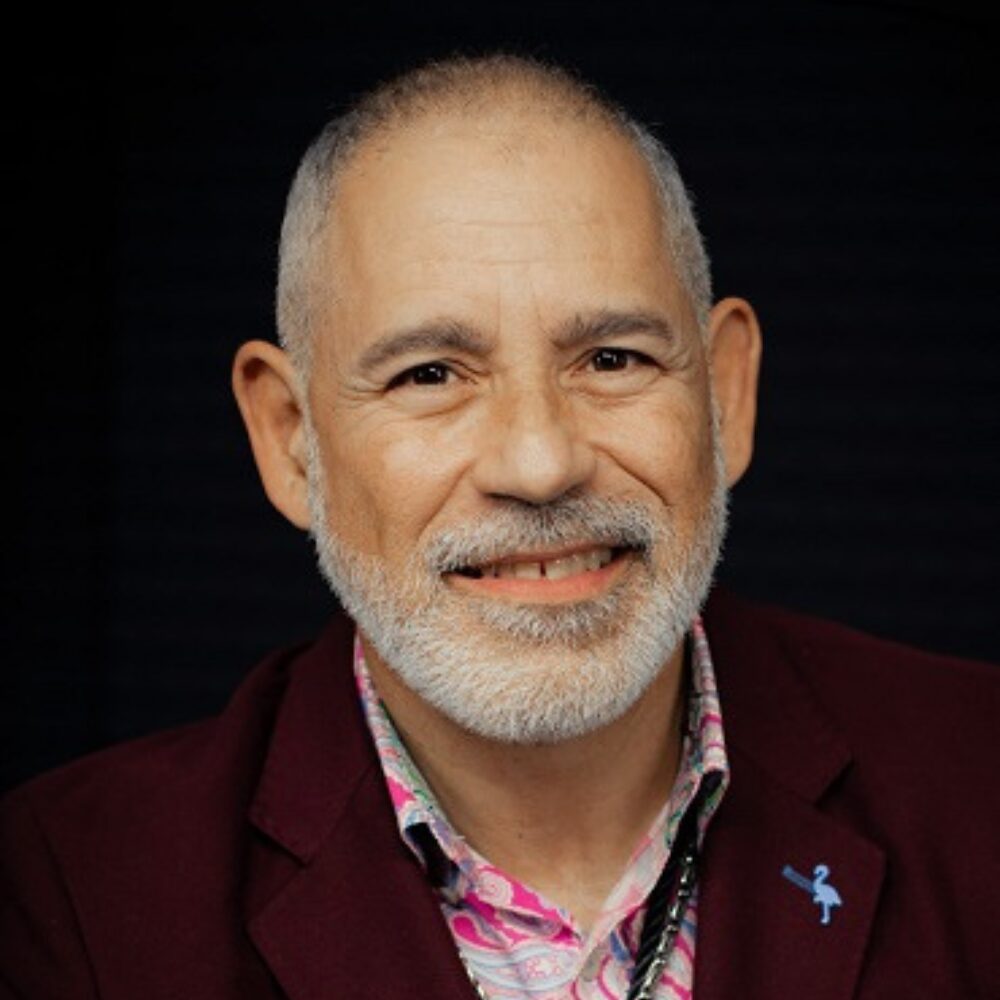 Oscar García-Johnson is Professor of Theology and Decolonial Studies at Fuller Theological Seminary, an ordained minister in the American Baptist Churches USA, and an activist-scholar with La Fuente Ministries. He is the author of Decolonial Love in Times of Hatred, Embracing Fear: Christian Reexistence in the Trump Era, and Introducción a la Teología del Nuevo Mundo.
About This Series
This article is the third installment in a four-part series based on themes explored in Embracing Fear: Christian Reexistence in the Trump Era. Throughout Hispanic Heritage Month, the series reflects on fear, migration, belonging, public witness, and Christian hope in anxious times.
Next: Cracking Babel: Pentecost Reexistence in a World of Walls.
The views and opinions expressed in this blog are those of the individual authors and do not necessarily reflect the official position of the Center for Public Theology & Migration. This platform exists to foster thoughtful theological reflection, dialogue, and public engagement on issues related to (im)migration.
