We live in an age of walls. Some walls are physical. Others are political.
Others are cultural, theological, racial, linguistic, and emotional.
We build them because we are afraid.
Throughout this series, I have argued that fear has become one of the defining spiritual and political realities of our time. Fear shapes public imagination. Fear fuels authoritarian forms of belonging. Fear teaches us to seek refuge in conformity and security rather than vulnerability and trust.
Yet fear is not the final word.
Neither is empire.
The final question of Embracing Fear is not what we are against. The final question is what future we are building.
If Babel represents humanity’s attempt to secure the future through control, then Pentecost reveals God’s alternative.
Pentecost is God’s answer to a world of walls.
Cracking Babel
The story of Babel begins with a desire for security.
The migrants who became settlers feared dispersion. They feared uncertainty. They feared a future they could not control. In response, they sought permanence through uniformity: one language, one project, one center of power.
The result was Babel.
A social imagination organized around fear.
A vision of belonging built through control.
An attempt to overcome vulnerability by eliminating difference.
The logic of Babel continues to shape our world.
Whenever nations define themselves through exclusion, Babel lives.
Whenever churches demand conformity as the price of belonging, Babel lives.
Whenever communities imagine safety through walls rather than relationships, Babel lives.
Yet God’s response to Babel is remarkable.
God does not answer Babel with a bigger tower.
God does not answer Babel with another empire.
God interrupts Babel’s logic.
The Spirit begins to crack open the world Babel tried to close.
Those cracks matter. Because through them another future becomes visible.
Scripture repeatedly reminds us that God’s future rarely emerges from the centers of imperial power. The prophets learned to look elsewhere. Speaking to a people overshadowed by kingdoms and armies, Micah announced:
But you, O Bethlehem Ephrathah, who are too little to be among the clans of Judah, from you shall come forth for me one who is to be ruler in Israel, whose coming forth is from of old, from ancient days (Mic. 5:2, ESV).
Bethlehem was not Jerusalem.
It was not the seat of power.
It was not the center of religious authority.
It was small, peripheral, and easily overlooked.
Yet God’s future emerged from precisely such a place.
The same pattern appears throughout Scripture. Virgil Elizondo, one of the fathers of Latino/a/x theology, called it The Galilean Principle. God repeatedly chooses what empires consider insignificant in order to reveal possibilities empires cannot imagine. A shepherd confronts a giant. A young woman from Nazareth bears the Messiah. A crucified Galilean inaugurates God’s kingdom. A multilingual gathering of ordinary disciples becomes the birthplace of the church.
Pentecost belongs to this same divine pattern. The Spirit does not begin with the powerful. The Spirit begins with communities that have learned to trust God’s future more than imperial certainty.
Pentecost and the Healing of Babel
Many Christians understand Pentecost primarily as a miracle of communication.
It is certainly that. But Pentecost is also a miracle of social imagination.
The Spirit does not reverse Babel by returning humanity to one language.
The Spirit heals Babel without eliminating plurality.
Many languages remain.
Many peoples remain.
Many cultures remain.
Many histories remain.
The miracle is not sameness.
The miracle is communion.
This is one of the most profound political and theological claims in Scripture.
Pentecost refuses the imperial dream of a single universal authorized world. It refuses the assumption that one language, one culture, one nation, one theology, or one civilization possesses the whole.
Instead, the Spirit creates communion across difference. A pluriverse.
Difference is not erased.
Difference becomes the place where God’s presence is revealed.
For this reason, Pentecost offers more than a theology of mission. It offers a vision of what decolonial thinkers call a pluriverse—a shared world where many worlds can coexist without one claiming the right to dominate all others.
The Spirit creates not monocultural conformity but pluriversal conviviality.
Not controlled by fragmentation.
Not attracted to assimilation.
But constituted by Communion.
Practicing Mañana
This is where Pentecost becomes deeply relevant for migrant communities.
Migration constantly confronts people with difference.
Different languages.
Different customs.
Different memories.
Different futures.
The temptation is either assimilation or separation.
Become the same or remain strangers.
Pentecost offers another possibility.
Conviviality.
Shared life without erasure.
Belonging without domination.
This is why I have increasingly found hope in what theologian Justo González called mañana.
Mañana is not optimism.
It is not wishful thinking.
It is not procrastination.
It is not confidence that history will naturally improve and balance up.
Mañana is the conviction that God’s future is already pressing into the present.
It is the ability to live today according to a future that has not yet fully arrived.
Many migrant communities understand this intuitively.
They build families, businesses, congregations, and neighborhoods while living amid uncertainty with faith.
They cultivate life before guarantees exist.
They practice tomorrow before tomorrow arrives.
They become signs of a future still coming into view.
In this sense, Pentecost is not merely an event in the church’s past.
It is a way of inhabiting the present that empire cannot control.
Crossing Abyssal Lines
The world continues to organize itself through divisions.
Citizen and foreigner.
Legal and illegal.
Civilized and uncivilized.
Safe and dangerous.
Belonging and exclusion.
Boaventura de Sousa Santos calls these divisions abyssal lines—social boundaries that separate those whose lives are considered fully visible and valuable from those rendered invisible or disposable.
Empire depends on such lines.
Pentecost crosses them.
The Spirit repeatedly moves toward those whom dominant systems attempt to place outside the circle of belonging.
This is why re-existence is ultimately more than resistance.
Resistance opposes injustice.
Re-existence creates another way of being.
It crosses abyssal lines.
It builds relationships where walls once stood.
It remembers histories that empire forgets.
It cultivates communities where diverse peoples can flourish together.
Re-existence becomes the everyday practice of Pentecost.
The Future Belongs to the Spirit
The final vision of Embracing Fear is neither political triumph nor cultural victory.
It is not the replacement of one empire with another.
It is not the conquest of enemies.
It is not the fantasy of a fear-free world.
The future belongs to the Spirit.
And wherever the Spirit moves, Babel begins to crack.
Every act of hospitality becomes a crack in Babel.
Every act of solidarity becomes a crack in Babel.
Every multilingual congregation becomes a crack in Babel.
Every refusal to fear the stranger becomes a crack in Babel.
Every crossing of an abyssal line becomes a crack in Babel.
These acts may seem small. But these are the Acts of the Spirit rewriting our lives here and now.
And so did Pentecost.
A gathering of ordinary disciples.
A diversity of languages.
A fragile community in the shadow of empire.
Yet from that small beginning emerged a new social imagination that continues to challenge every empire that seeks to organize the world through fear.
The question facing Christians today is not whether walls exist.
They do.
The question is whether we will help build them or help crack them.
Will we continue to imagine the future through fear?
Or will we become Pentecost people?
People who cross abyssal lines.
People who cultivate pluriversal conviviality.
People who embody re-existence.
People who practice God’s mañana in the present.
The Spirit’s answer to a world of walls has always been communion. It has never been uniformity.
Follow us on Facebook, Instagram, and Youtube for more content like this.

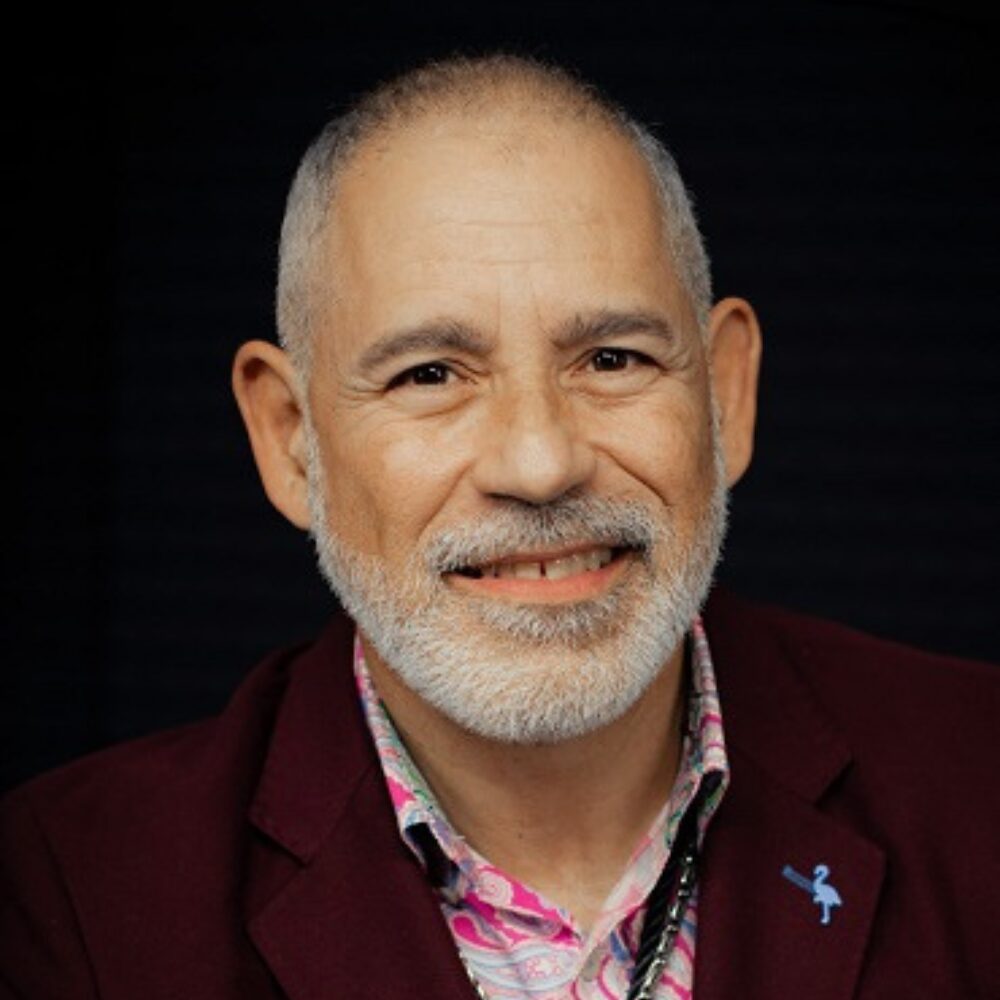 Oscar García-Johnson is Professor of Theology and Decolonial Studies at Fuller Theological Seminary, an ordained minister in the American Baptist Churches USA, and an activist-scholar with La Fuente Ministries. He is the author of Decolonial Love in Times of Hatred, Embracing Fear: Christian Reexistence in the Trump Era, and Introducción a la Teología del Nuevo Mundo.