
As a white middle-class American, the vulnerabilities of the immigrant journey can often feel distant. The distance takes many forms, including historical distance. My family is a mashup of Northern European migrants, mostly poor farmers, all arriving in the United States in the nineteenth century. Swedish, German, and Norwegian languages were intentionally discouraged in the home in the early twentieth century, and our families easily merged into the white, anglophone, Protestant norms and privileges of American life. I study and write about migration, have worked in Christian ministries with and for migrants, have immigrant friends, have lived abroad as a (surely privileged) immigrant, but so many forces in American life continue to pull me away from the immigrant experience.
My identity as an American Christian in the twenty-first century compounds the problem, as many who share my religious identity are widening the gap, driving immigrants further into the shadows. In this Advent season, I want to share an unexpected yet powerful experience with an ancient Christian tradition that puts the migrant journey at the heart of our faith.
This summer I traveled to Cairo, Egypt, to conduct interviews of Christian leaders, all Egyptian, who were engaged in holistic transformation in their communities. I was seeking to learn the contextual paradigms and practices that shaped their faith-driven work. Trips like these are full of cultural and economic whiplash, as short car rides take me between air-conditioned hotels with armed guards and neighborhoods shaped by poverty, war, and neglect.
I woke up early in the morning on June 10th, still struggling with jet lag. After lying in bed for a few hours, I turned on my news feed to pass the time. At the top of the feed were pictures of the immigration protests that had broken out in Los Angeles as well as reports of the administration sending in the military. The news made my heart sick. I also felt helpless and a bit aloof, sitting white, safe and alone in a nice hotel room, thousands of miles away from my native California. The chaotic images on the bright screen and the quiet, dark room made the feelings of disconnect even worse. I felt a thin line of connection, though, as my plans that day included a visit to one of Cairo’s many migrant neighborhoods to interview a couple who ran a center for refugees – mostly from Sudan and Syria, two places devastated by civil war. I knew, at the very least, I would be touching the hidden worlds of migration in some small way. The migrant world that touched me the most that day, however, came from a different hidden place.
Before the interview, I snuck in a few hours of spiritual sightseeing. I did not want to miss Old Cairo, the historic center of the Coptic Church in Egypt. The ancient church traces its origins partially back to the missionary work of St. Mark, but the church roots its identity even earlier, in the immigrant journey of the Holy Family.
As I rode in the back seat of the taxi toward the old city, I remembered reading about the Church of the Holy Family. The church is known by other names: Abu Serga (after the martyrs Sergius and Bacchus) or simply “The Cavern Church.” The Church is where, according to tradition, Jesus, Mary, and Joseph slept in a cavern after their escape from Herod’s violent political crackdown in Bethlehem. Early followers of Christ built the church over the cavern. The first century cavern is still there and still has a stone where, it is said, the infant Jesus rested his head.
As the taxi took me down Cairo’s noisy streets, I had images of California floating through my head: protesters beaten back by police, families ripped apart, and the thousands of immigrants not on the streets, hiding in the shadows. The closer we got to Old Cairo, the more I knew I needed to go to the Church of the Holy Family.
I walked into the old city, and as I turned the corner of an ancient alley, the church’s entrance stood before me. It was simple, beautiful in a way but not grand, with a stone carving of the Holy Family sojourning in Egypt at the entrance. In a time when I am sometimes ashamed to be a Christian in America, here was the most Christian of spaces, dignifying – and even deifying – the migrant journey. I entered into the sanctuary and my eyes and senses were flooded with immigrant images mixed with worship and devotion. Images that had been there for hundreds of years, some over a thousand. And there was nothing politicized about the space. It was just communicating a fact: our Lord is a migrant. The Holy Family were sojourners. Here was a church that took pride in its immigrant identity. The space was holy because Jesus had slept in the church basement. I saw maps, tracing the boy Jesus’ sojourn around Egypt, making the places and spaces sacred by his wandering presence. We are not simply called to care for the immigrant. We are an immigrant people, the wandering Holy Family is holy, and our God is an immigrant God.
I left the sanctuary – or rather, went deeper in – and entered a dark staircase that took me down into the ancient cavern that sheltered Jesus, Mary, and Joseph. Here was the church in its purest form. The walls narrowed and the darkness grew thick. There were a few lights and candles, a few sacred objects, but mostly just hard, dark brick and stone. Our God wraps the migrant journey in all its fullness into his life, a journey that captures the world’s beauty and brokenness. The space was cramped and cold, the air stale. I felt the fear, isolation, and vulnerability of the Holy Family and all holy families who sojourn in hopes for a better life.
I walked up, out of the dark cavern and back into the sanctuary, my whole being pressed down by the moment. I felt a weight, both holy and cursed, at the same time. All I knew to do was pray. Sometimes, “thoughts and prayers” are cheap. But not always. I sat down in a pew, surrounded by images of my immigrant God, and prayed and wept for our world. Prayer can keep us at a distance, especially when not wedded to action, but prayer can sometimes draw us deeper in, into the unseen places of good and evil. Prayer can expand our vision of God and neighbor. Prayer can invigorate us for our journey with Jesus and his holy family in a broken world.
Months later, I still often feel removed and conflicted as I consider how to engage the crisis our country, church, and world are in. Most days I wrestle with my own privilege and the safe distance race, culture, and money afford me. But when I left the Church of the Holy Family, I was glad to be a Christian, to be bound to a God – and a community – that draws me into fellowship with the Holy Family and all Holy Families who yearn, wander, and work for that better city (Hebrews 11:16; 12:13-14).
ABOUT THE AUTHOR:
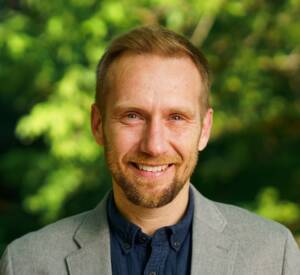 Tyler Lenocker grew up in California and now lives with his family in Massachusetts. He is a Visiting Researcher at Boston University in the Center for Global Christianity and Mission. His scholarship focuses on migration, urbanization, and World Christianity. Tyler’s early experiences working in vulnerable communities created a lifelong commitment to connecting and surfacing the stories of Christians of diverse cultures, experiences, and backgrounds.
Note: Photo provided by Tyler Lenocker.
